
Originated in India and spread to Persia, then the Middle East, and eventually Europe, chess is a game that has been around for centuries. The Europeans probably learned about chess from one of their visits to the Middle East or trade with the Eastern Romans.
Here’s what we know about how it evolved: Originally called “chaturanga,” chess was played on an 8×8 board and pieces could move only in straight lines (horizontally or vertically). Around 600 AD, chaturanga arrived in Persia where it was renamed “shatranj.” Shatranj pieces could also move diagonally as well as horizontally or vertically which made the game more interesting than its ancestor.
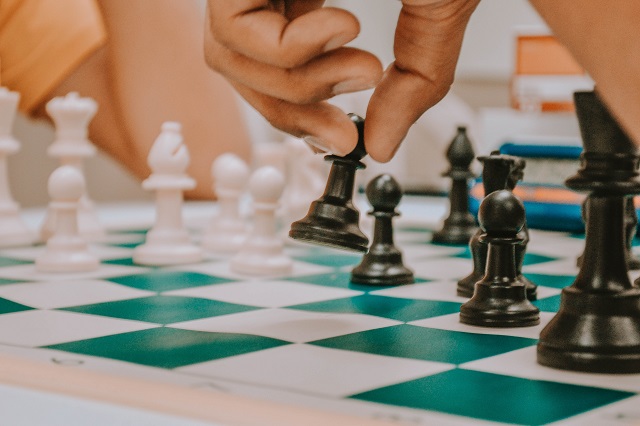
The game of chess we know today developed from shatranj and has remained relatively unchanged for the past thousand years or so. So, if you’re just getting started in the game, you can be assured that the basic rules have been around for a long time and aren’t going to change anytime soon! Now that you know a little bit about the history of chess, let’s move on to learning how to play.
The basics
To understand the basic principles of chess let’s start by understanding the pieces of the game. The board on which the chess pieces are moved is a grid with eight squares vertically and horizontally. Two interchanging colors, most commonly black and white, dictate how some of the pieces are moved (like the bishop).
There are two equal sets of pieces, each containing eight pawns, two rooks, knights and bishops, and one kind and queen. The pieces are different sizes and shapes so it’s easy to tell them apart. In addition, some players like to use chess clocks to time each player’s moves. This prevents either player from taking too much time to think about their next move.
Professional chess players sometimes play “blitz chess,” in which each player only has a few minutes to make all of their moves.
The object of the game
The goal of the game is to put your opponent’s king into checkmate, meaning that there are no moves left the opponent can do without exposing his piece to being taken down by one of your own . It takes strategic planning, predictive assumptions, and good instinct to play a chess duel, but it offers many rewards (in addition to winning). There are three ways to achieve checkmate:
1) By trapping the king so that it cannot move.
2) By putting the king in a position where it will be captured on the next move.
3) By forcing the king to move into a position where it will be in checkmate on the following move.
Types of chess pieces
There are six different chess pieces, and each piece has its unique way of moving
- The king is the most important piece, however is limited to move only one square at a time, but in any direction. The only exception to this rule is that the king cannot move into check (which we’ll explain later).
- The queen is the most powerful piece, and it can move vertically, horizontally or diagonally, similarly to the bishop (without a limit of squares per move) and on both colors.
- The rook moves in a straight line (forward, backward, left or right) without being limited by the number of fields it can go through in a single move.
- The bishop can move diagonally, and only through squares of the colors it is positioned on..
- The knight is the only piece that can “jump” over other pieces, and it can move two squares in one direction and then one square to the side. The knight can move either forwards, backward, or sideways.
- The pawn is the weakest piece, and it can only move one square at a time. The exception to this rule is that pawns can move two squares on their first move. Pawns can only move forward, but they capture other pieces by moving diagonally.
How the game is played
The game of chess is usually played between two people, but some variations involve more than two players. Each player has their color of pieces (traditionally white and black), and the game starts with each player having 16 pieces. The game can also be played online, and there are even chess computers that can play against humans.
The game starts with each player making their first move. The player with the white pieces always goes first, and then players alternate taking turns. A player can only move one piece per turn, except pawns which can move two squares on their first turn.
Players continue taking turns until one player checkmates the other player’s king. As we mentioned before, checkmate happens when the king is under attack and cannot escape.
Playing chess is a great mental workout and it may take time for you to learn the basics. However, once you get the hang of it, many benefits come with playing chess: better memory recall, improved problem-solving skills, and heightened ability to think strategically. You can even play online against other players from around the world!
Chess also offers an opportunity for socialization as well-you might make some new friends while playing online or in person. With all these benefits at your fingertips (and no downsides), why not give this game a try?
Keep being AllDayChic!