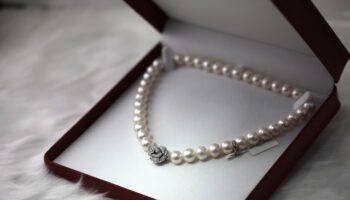
In most cases, people try to imitate natural stones of exorbitant price and amazing beauty. The consumer is offered synthetic analogs that are grown in laboratories and have the appearance and properties that are as close to their analogs as possible. One of these types of stones is the diamond, whose main artificial rival is moissanite.
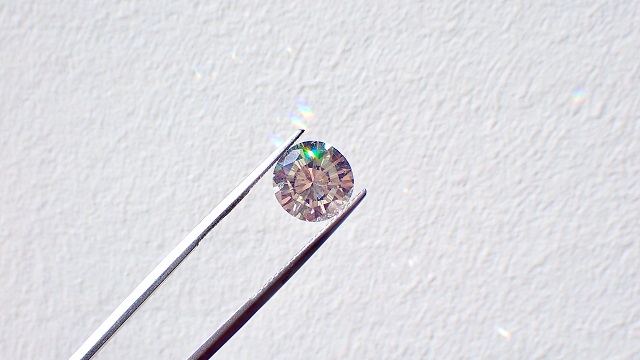
Synthetic Moissanite
There are two types of artificial Moissanite: technical and gem-quality. Technical crystals have a dark coloring, while jewelry stones are characterized by absolute transparency, purity, and shine.
Moissanite and Diamonds
Both stones have identical compositions, but their properties are slightly different:
- a diamond sinks in water, moissanite remains on the surface;
- moissanite takes on a green hue when exposed to open fire, while the diamond’s color does not change.
- on the surface of a diamond, there are visible traces of grease from touching it, which is not characteristic of moissanite;
- examining the growth zones of synthetic moissanite under a microscope, it is possible to see uniformly arranged rounded grooves, while diamonds have chaotically arranged zigzags and areas of unusual shape;
- artificial moissanite has a brighter luster than diamonds.
Mineral deposits
The main places of extraction of natural moissanite are meteorites that have fallen to Earth. In small quantities, the mineral can be found in terrestrial rocks, such as sapphire deposits, kimberlite pipes, and diamond nuggets.
The size of the grains is usually no more than 4 mm, so they are not used for anything other than collecting.
Storage and care
Synthetic moissanite is strong and durable. Such a stone requires a minimum of care. It is enough to protect it from a hard blow, strong pressure, as well as from prolonged exposure to moisture or sunlight.
Moissanite is kept, usually, in a separate box so it does not scratch the less solid stones. When the stone is dirty, it can be washed in warm water and dried immediately.
Cost
Natural moissanite belongs to rare minerals. The production of synthetic crystals is expensive. These factors, as well as weight, purity, and quality of processing, affect the cost.
The price of synthetic moissanite is approximately 10% of that of a diamond of similar quality, i.e. it ranges from $250 to $600 per 1 carat.
The most expensive is the colorless moissanite with a high degree of transparency. Crystals with green and blue hues cost 50-60 dollars less. Yellow, light brown, and black crystals cost even less (up to $80 less). On the contrary, moissanite crumbs up to 2 mm in size have a higher price than diamonds.
The price of a piece with a stone is also influenced by the material of the setting. For example, a moissanite engagement ring in gold costs between $340 and $690 per piece. Earrings in silver with stones with a diameter of 6.5 mm – $370.
How to wear it?
Visually, moissanite differs from a diamond only in its brighter luster. When choosing it as a jewelry piece, one should consider the color and size of the stone, the event, and the time of day:
A pendant with a miniature stone and moissanite earrings will favorably emphasize a business suit.
Long earrings, bracelets, rings, and necklaces with colorless and completely transparent crystals are an integral part of the evening closet. Jewels with moissanite are worn at evening receptions and status events.
Keep being AllDayChic!