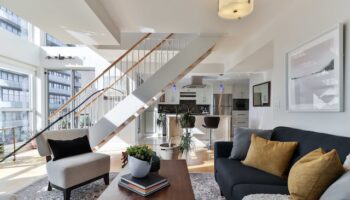
The living room is more than a space where you and your family can unwind at the end of the day and host your guests at events; it’s also a room where you can display your personality and that of your loved ones.
It’s believed that the significance of having a revitalizing living room layout design has been appreciated during the past few months when a majority of the world remained indoors.

If you’re considering designing a compelling living room space but don’t have the knowledge of how to go about with it, you’re in luck. Below is a guide that helps you resolve this issue by outlining the basic principles you should know to create a compelling living room design.
1. Principle Of Scale And Proportion
Scale refers to an object’s relative size to the space it’s positioned or another item. In contrast, proportion refers to the ratio between one part’s size to another. These two principles are interconnected because they focus on the size and link between decorative items in your living room space. Taking note of the principle of scale and proportion is vital when placing things in your living room to ensure maximum use of the available floor space.
Considering the principle of scale and proportion is especially crucial when deciding the furniture for your living space. For instance, when you buy teak furniture, make sure it’s of an appropriate scale and proportion to prevent it from appearing too big or small for the room. And with scale and proportion having such a significant effect on making your living room appear bigger or smaller, you shouldn’t ignore its importance.
2. Principle Of Harmony
The different spaces and objects throughout your living room must complement and work with each other to make it feel like a whole. As a result, this creates unity and removes any feeling of instability that might have been present in your living room. The principle of harmony essentially brings together all the other principles that give the interior space a sense of oneness when done correctly.
Harmony in the living room design applies to how color, décor, and furniture seamlessly fit together, either along with a specific aesthetic, mood, theme, or style. This makes everything in your living room feel that they’re indeed in the proper position.
3. Principle Of Balance
This interior design principle aims to give your living room space a sense of equilibrium by estimating or equalizing an object’s visual weight. There are different ways to realize balance, including pattern, color, texture, and shape. Once the proper balance is realized, your living spaces will have symmetry and equality.
The three different types of balance followed when creating your living room design include:
- Formal or symmetrical: It’s the most common kind of balance and entails placing objects and furniture fixtures directly opposed to each other. This balance gives your living space a sense of calm and serenity but it can feel boring and monotonous.
- Informal or asymmetrical: This form of balance gives you greater creative freedom meaning the visual weights of colors, textures, forms, and lines are balanced yet not an exact replication. While it’s less structured than symmetrical balance, it’s more pleasing to the eye.
- Radical: This type of balance is when an interior space’s elements originate from a central focal point. For example, chairs are arranged around the dining table. Radical balance can be characterized by texture, color, and form repetition.
When searching for balance, the best place to start would be by finding a focal point in your living room space. This can either be a fireplace, a television, or a big piece of art.
4. Principle Of Rhythm
The technique of creating flow in your living room design to allow for free movement of your eyes across the interior space is referred to as rhythm. The different methods of creating rhythm in your house’s living room are:
- Transition: It’s often used as a strong line, a furniture piece, or an architectural feature to create a continuous flow of objects throughout the entire space. Examples include dining tables, draperies, stair railings, and countertops.
- Repetition: This essentially means echoing certain design elements across your living room space. The different design elements used include colors, form, light, line, texture, patterns, and fabrics. By repeating these design elements, designers will give your interior space flow.
- Progression: This point under the rhythm principle adds a sense of depth when used in a particular manner. The different ways of implementation include the graduation of shape, size, and color. A good example of the progression element in the living room includes getting nesting tables of different sizes.
Takeaway
You can only create a refreshing living room design by ensuring it’s placed in the correct position and observing essential design elements. Knowing this as an average homeowner can be too beyond understanding. This content feature aims to ease your troubles by detailing the basic principles you need to know about creating a compelling living room design.
Keep being AllDayChic!